



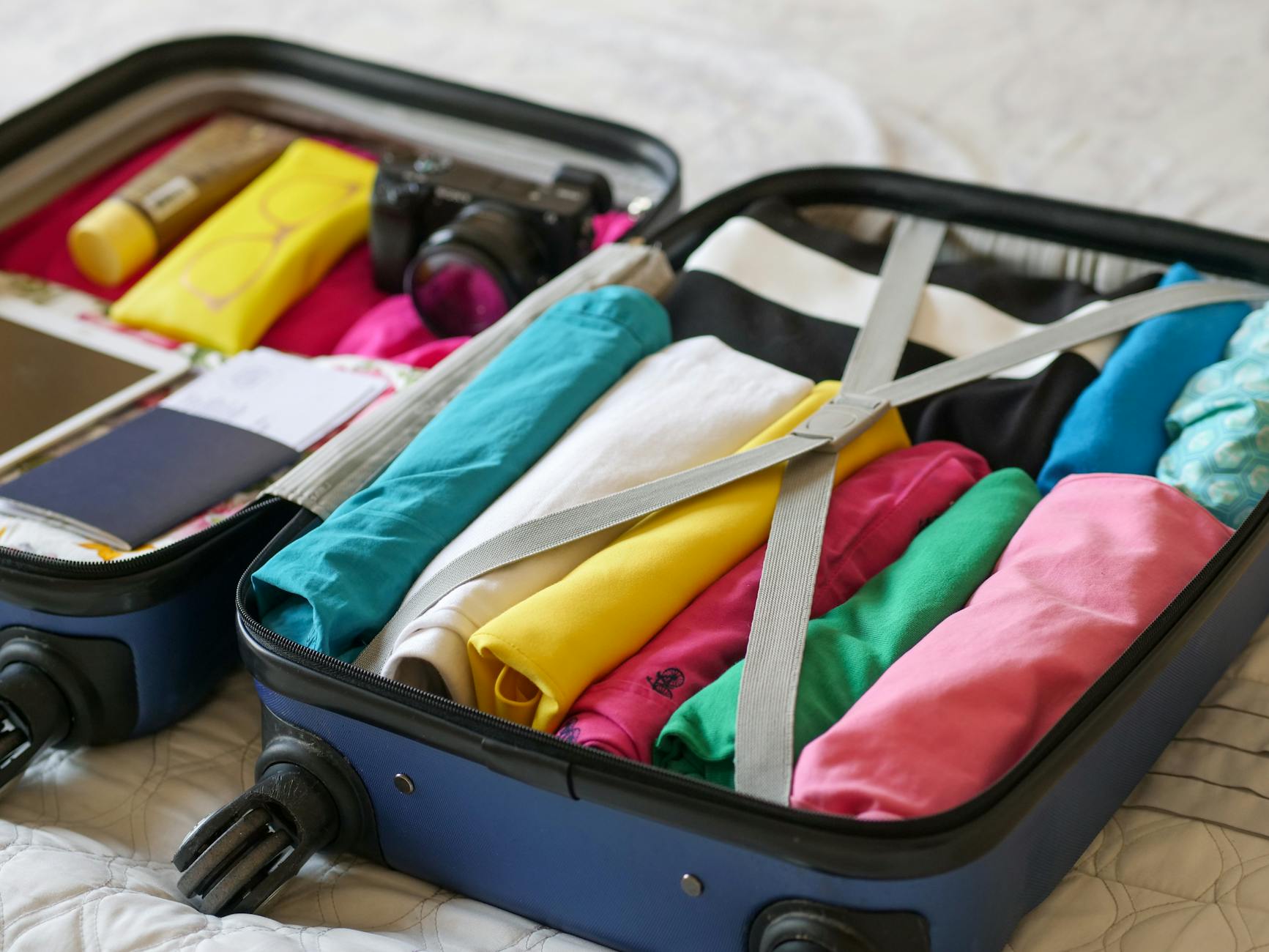
Photo by Kindel Media on Pexels
Why Quartile Packing Works
Ever stared at a half‑full suitcase and felt like you were still over‑packing? The secret isn’t in buying a smaller bag; it’s in how you divide the contents. By thinking of your luggage as four equal quartiles, you force yourself to prioritize, compress, and organize. The brain loves visual boundaries, and when you see four clearly defined sections, you naturally ask, “Do I really need this item in quartile #2?” This mental checkpoint trims excess before it even touches the bottom of the bag.
Statistical studies on packing efficiency show that travelers who segment their luggage reduce overall weight by 12‑18 % on average. The trick is not the math but the habit: every item must earn a spot in one of the four boxes. The result is a lighter suitcase, lower airline fees, and more room for souvenirs.
The 4‑Item Rule Explained
The core of the quartile system is the 4‑Item Rule. Choose four versatile pieces that can serve multiple purposes across your trip. These become the backbone of each quartile, allowing the remaining items to be accessories rather than essentials.
- Base Layer – a neutral‑colored t‑shirt or long‑sleeve that can be dressed up or down.
- Bottom – a pair of travel‑friendly pants or a skirt that works for both daytime exploring and evening dining.
- Outer Layer – a lightweight jacket or cardigan that folds flat and adds warmth.
- Multipurpose Item – think a scarf that doubles as a blanket, a sarong that can become a beach cover‑up, or a packable rain poncho.
Once these four items are placed—one in each quartile—the remaining space is reserved for:
- Toiletries (in a clear, refillable pouch)
- Electronics (compact charger, earbuds)
- One‑or‑two “special” pieces (a dress for a nice dinner, a pair of shoes for a hike)
Because each quartile can only hold a limited number of extra pieces, you instinctively choose the lightest, most compressible options. Rolling, bundling, or using compression cubes becomes a game of fitting items into a pre‑set grid rather than a chaotic dump.
Real‑World Applications
Case Study 1: 7‑Day European City Hop
Maria packed a 25‑liter backpack for a week‑long trip to Paris, Berlin, and Amsterdam. She applied the 4‑Item Rule:
- Base Layer – a white merino tee (odor‑resistant, wear‑multiple‑days)
- Bottom – a pair of stretchy black chinos
- Outer Layer – a packable waterproof trench coat
- Multipurpose – a silk square that served as a scarf, headband, and makeshift tote
All extras (two additional tees, a dress, a pair of sandals, toiletries) fit neatly into the remaining three quartiles, leaving 10 cm of empty space for souvenirs. Her bag weighed 4.2 kg, well under the 7 kg airline limit.
Case Study 2: 10‑Day Adventure in Patagonia
Jake needed rugged gear but still wanted to stay light. He chose:
- Base Layer – a moisture‑wicking long‑sleeve
- Bottom – convertible hiking pants
- Outer Layer – a down‑filled, compressible jacket (packed to 15 cm)
- Multipurpose – a fleece‑lined neck gaiter that could become a pillow
The remaining quartiles held a compact sleeping bag, a pair of trekking poles (disassembled), and a small first‑aid kit. Total pack weight: 6.8 kg, 2 kg lighter than his usual setup, and he still had room for a camera.
Both examples illustrate that the rule works for city‑breaks and rugged treks alike. The key is to select items that truly serve multiple functions and to respect the visual limits of each quartile.
FAQ
1. What if I need more than four clothing items for a longer trip?
Stick to the quartile framework but rotate items weekly. Pack a second set of the four core pieces in a separate compression sack and swap them out at a midpoint. This keeps the initial load light while still providing fresh clothing.
2. Can the 4‑Item Rule be applied to a carry‑on and a checked bag together?
Absolutely. Treat the carry‑on as quartile #1 (your most essential items) and the checked bag as quartiles #2‑#4. This ensures you always have a functional outfit in case your checked luggage is delayed.
3. How do I handle bulky items like boots or a camera tripod?
Allocate an entire quartile to a single bulky item if it’s non‑negotiable. Then, fill the remaining three quartiles with the 4‑Item core and compressible accessories. Often you’ll find that you can replace heavy boots with versatile trail shoes that fold flat, freeing up a whole quartile.
Found this helpful? Share it with fellow travelers! ✈️
0 comments:
Post a Comment